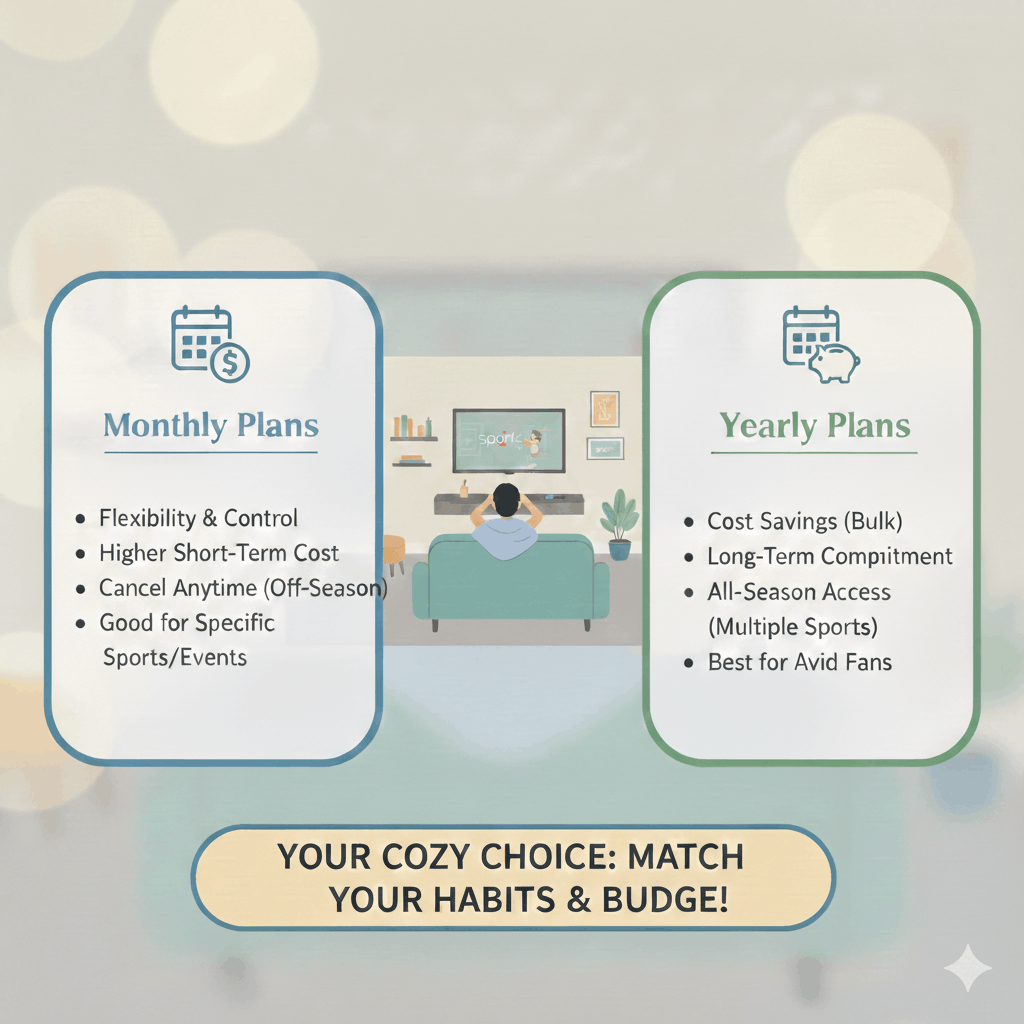
Monthly vs yearly sports plans: Simple, Comforting way to choose the right deal
Monthly vs yearly sports plans look like a basic billing choice until you live with it for a season. One person pays monthly, cancels after the playoffs, and feels in control. Another pays yearly, forgets to use it during the offseason, and feels like money leaked out quietly. Both made a logical decision, yet their habits were different, so the result was different too.
This guide is written to make monthly vs yearly sports plans feel clearer. You’ll learn what annual subscription meaning really implies in sports streaming, how to compare monthly vs yearly sports plans cost without getting tricked by small-print value gaps, and how to decide if it is better to pay yearly or monthly for your specific viewing routine.
What annual subscription meaning really implies in sports streaming
Annual subscription meaning is simply paying for 12 months under one billing cycle. In sports streaming, though, the value does not spread evenly across the year because sports do not spread evenly across the year.
You might watch football heavily for a few months, then barely watch anything for weeks. You might watch basketball weekly for most of the year. You might be a casual viewer who only watches finals, rivalry games, or a handful of nights.
That uneven calendar is the first reason monthly vs yearly sports plans can feel confusing. A yearly plan only feels “worth it” when your use is steady or when the service stays valuable even outside the main season through replays, shoulder content, and other competitions you care about.
Why sports plans can still feel incomplete even when you pay yearly
A second reality is that sports subscriptions are rarely one clean bundle. A plan might cover certain games, yet require a higher tier for specific channels, or restrict certain matchups based on local market rules. The billing cycle does not change those limitations.
So a yearly plan is not automatically “all access.” It is a longer commitment to one platform’s package, and that package can still have gaps. When people feel frustrated after buying annual, it’s often because they paid for time, not for complete coverage.
Monthly vs yearly subscription: the true trade-off
Monthly vs yearly subscription is really a trade between flexibility and certainty.
Monthly offers control. You can cancel whenever your interest drops, switch platforms if your favorite competition changes home, and avoid paying during months you won’t watch.
Yearly offers simplicity. You usually pay less per month, you stop thinking about billing, and you keep access ready for surprise nights when your team plays and you want to watch without scrambling.
The mistake is treating this as a personality test. The better way is to treat it as a habit test.
The habit test that makes this decision easier
Ask yourself what happens in a normal month:
Do you watch sports weekly, or only occasionally
Do you open the app even when your team isn’t playing
Do you rely on replays and highlights during the week
Do you have long breaks where you don’t watch anything
Do you follow multiple leagues that sit on different platforms
Your answers are basically the blueprint for monthly vs yearly sports plans. This is why two people can choose opposite options and both be “right.”
Monthly vs yearly sports plans cost: how to compare without getting fooled
Monthly vs yearly sports plans cost comparisons often trick people because they assume you will watch all 12 months. Many fans do not. A fair comparison uses the months you realistically watch, then adds the hidden costs that are easy to miss.
Here is a simple way to compare without overthinking.
Step one: count your real watching months
Think of the last year. How many months did you actually watch live games, not just browse scores?
Some patterns look like this:
Season-only viewer: 3–5 months
Regular season + playoffs viewer: 5–8 months
Weekly viewer: 8–10 months
Multi-sport household: 10–12 months
You don’t need to be perfect. You just need to be honest. Monthly vs yearly sports plans make sense only when they match reality.
Step two: compare your real total, not the headline math
Multiply the monthly price by your real watching months. Compare that number to the annual price.
If the annual plan is only slightly cheaper than your real monthly total, flexibility may be the better deal even if the annual looks “discounted.” If the annual plan is clearly cheaper and you know you’ll use it, annual starts to make more sense.
Step three: add the “quiet costs”
This is where many comparisons break.
Add-on tiers: some sports channels sit behind a sports add-on or higher tier
Household streams: some plans charge more for multiple screens
Taxes and platform fees: small differences become real over 12 months
Offseason value: if you won’t use it, it’s not value
Monthly vs yearly sports plans cost is not only about price. It’s about total cost for the exact access you need.
Annual vs monthly subscription pros and cons in sports, not theory
Annual vs monthly subscription pros and cons look different in sports than in music or general entertainment because sports has seasons, local rules, and unpredictable match placement.
Monthly pros and cons: where monthly shines and where it bites
Monthly gives you flexible control. It fits playoffs-only viewing, travel-heavy schedules, and anyone who follows more than one sport on different platforms. It’s also the safest choice when you’re testing a platform for the first time.
Monthly can bite when you forget to cancel. It can also end up costing more across a long season. Another issue is that some services give better value in annual bundles, such as bundled extras, bonus content, or a slightly better effective rate.
Monthly is best when your calendar is short or uncertain.
Annual pros and cons: where annual wins and where it becomes regret
Annual often wins when you watch consistently. It is also helpful for people who hate managing subscriptions. You pay once, and you stop thinking about it.
Annual becomes regret when the season ends and you stop watching, or when you discover your must-watch games are not in that package. Annual can also feel painful when rights shift and your favorite competition moves elsewhere mid-year, making your long commitment feel less useful.
Annual is best when your usage is steady and you’ve already confirmed the service fits you.
Is it better to pay yearly or monthly: a practical answer
Is it better to pay yearly or monthly depends on the value of flexibility in your life.
Pick monthly if you match most of these:
You only watch for a few big weeks
You follow one sport and ignore the offseason
You like switching services when coverage changes
You are testing a platform for the first time
Your budget requires strict control month to month
Pick yearly if you match most of these:
You watch weekly through most of the year
You use replays and shoulder content regularly
You want one stable setup that stays ready
You hate login and billing management
You are sure the package covers your must-watch games
This is the cleanest way to answer monthly vs yearly sports plans without turning it into guesswork.
Saas monthly vs annual: why sports pricing feels the same
Saas monthly vs annual pricing is built on the same business logic you see in sports subscriptions. Companies reward longer commitments because it reduces cancellation rates and makes revenue more predictable. That is why annual plans usually look “cheaper” per month.
As a viewer, your job is not to chase the discount. Your job is to pay for the access you will actually use.
A good way to apply the SaaS mindset is this: treat your first month like a real test, then decide whether to commit.
A smarter way to buy so you avoid regret
Many people regret sports subscriptions not because of the price, but because they bought at the wrong time or bought without testing the real viewing experience on their main screen.
Start monthly, then decide with evidence
If you’re unsure, start monthly during a week that matters to you, not a quiet week. Test it during real match time, on your real TV, on your real Wi-Fi.
Pay attention to:
Stream stability on your main device
Replay availability
How quickly you can find the game
Whether important games are included or missing
How often you actually open the app during the week
After one or two real weeks, the “Is it better to pay yearly or monthly” question becomes obvious.
Buy annual only when the calendar supports it
Annual plans make more sense at the start of a long season when you expect heavy usage. They often make less sense if you’re buying late in the season unless the service provides year-round value through other competitions or a strong archive.
This timing detail alone improves monthly vs yearly sports plans decisions more than any discount percentage.
Don’t ignore household viewing patterns
One person watching alone is different from a household with two or three people streaming at once. Stream limits and device support can matter more than the plan price.
If you’re buying for a household, confirm how many streams you need, where you’ll watch, and which devices you use. A yearly plan that only supports one stream can create constant friction.
The common traps that make people feel “sports subscriptions are a scam”
It’s normal to feel annoyed when you pay and still don’t get what you expected. That usually happens because of one of these common traps:
Assuming yearly equals everything
Not checking which channels are included in the base tier
Ignoring local market restrictions
Buying annual late in the season
Not testing the service on your main screen first
These issues are why monthly vs yearly sports plans decisions should start with coverage and viewing habits, not just with a discount headline.
Conclusion
Monthly vs yearly sports plans are best decided by your calendar, not by the marketing page. Monthly is the better fit when your watching is seasonal, uncertain, or tied to a few big weeks. Yearly is the better fit when you watch consistently and want a stable setup with a lower effective cost.
If you’re unsure, the safest move is to start monthly during a real match week, test stream quality and coverage on your main device, then move to annual only if you can see yourself using it for most of the year.